How Do You Decorate an Apartment for Halloween?
Looking for renter-friendly Halloween decor ideas? Discover how to decorate your apartment with damage-free hacks, space-saving tricks, and stylish themes.
How to Decorate an Apartment for Halloween: The Complete Renter's Guide
Halloween is the most commercially active holiday season in the United States. The National Retail Federation reports that Americans spent $12.2 billion on Halloween in 2023, with home decorations accounting for $3.9 billion of that total — a record high (NRF, 2023). For apartment renters, that enthusiasm collides with a practical reality: security deposits, lease restrictions, and limited square footage make traditional decorating approaches risky or simply impractical. This guide covers exactly how to decorate an apartment for Halloween without damaging walls, cluttering tight spaces, or triggering landlord complaints.
TL;DR: Americans spent $12.2 billion on Halloween in 2023, with $3.9 billion on home decor alone (NRF, 2023). Apartment renters can achieve full Halloween atmosphere using adhesive strips, tension rods, window clings, and vignette-style decorating. This guide covers damage-free tools, room-by-room ideas, renter-friendly techniques, and budget strategies — no nails required.
For year-round small-space decorating principles that apply directly to seasonal setups, the full resource on studio apartment decor covers layout and visual layering in detail.
What Tools Do Renters Need for Damage-Free Halloween Decorating?
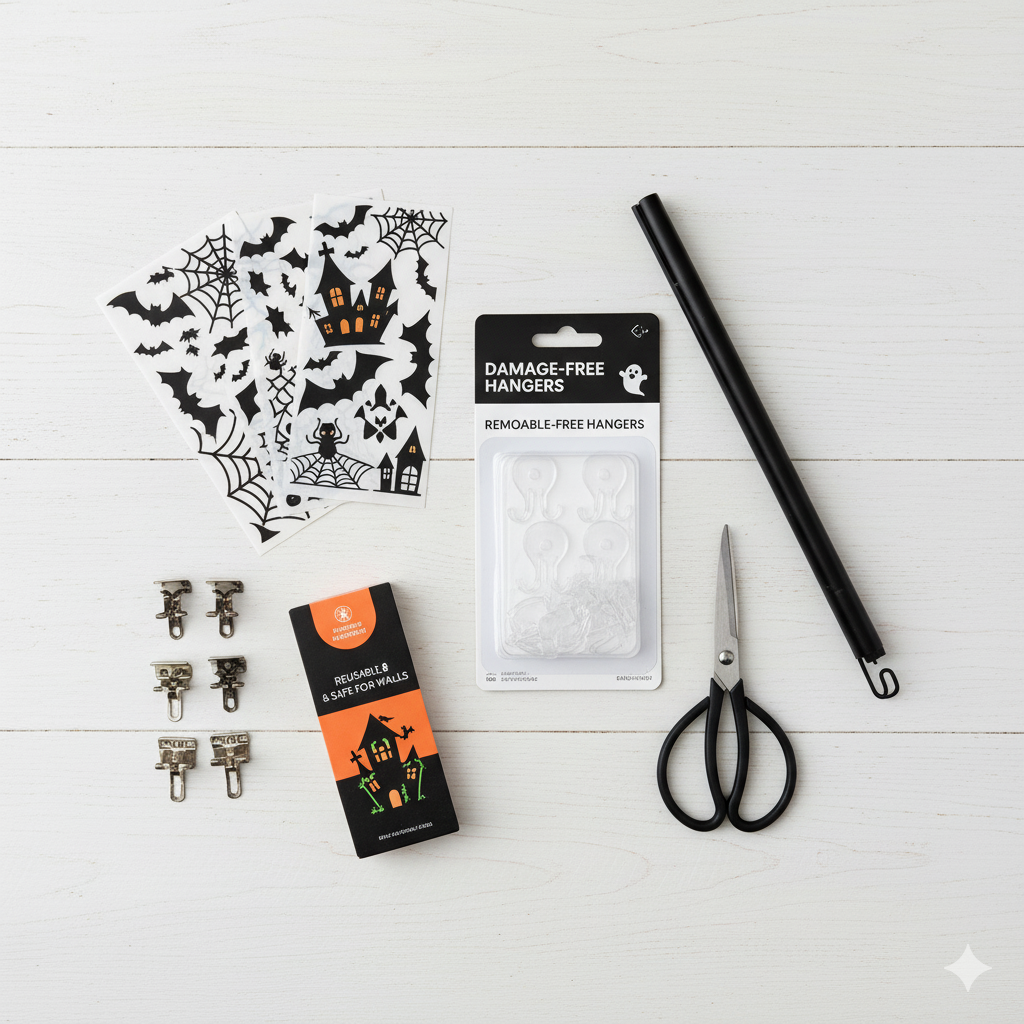
The right toolkit makes the difference between a Halloween apartment that impresses and one that costs a security deposit. The NRF found that 69% of Halloween decorators start planning their setups in September, suggesting that preparation time matters as much as the products chosen (NRF, 2023). Building a renter-safe toolkit before buying a single decoration eliminates the costly mistakes that come from improvising with tape and thumbtacks.
Adhesive hooks and strips are the foundation of renter-friendly decorating. Brands such as Command produce strips rated for specific weight loads — typically one, three, five, or seven pounds per strip. Matching the strip rating to the decoration's actual weight is essential; overloading a strip causes it to release from the wall, often taking paint with it. Always clean the wall surface with isopropyl alcohol and allow it to dry fully before applying any adhesive product.
Tension rods are one of the most underused tools in a renter's decorating kit. A spring-loaded tension rod fitted into a doorway holds fabric drapes, spiderweb sheers, or garland curtains without leaving any mark. They're available at hardware stores for under $10, fit openings from 28 to 120 inches wide, and remove in seconds. Used in bedroom doorways, hallways, or bathroom entries, they create dramatic threshold effects that transform the feel of an entire room.
Window clings and static-cling decals apply to glass surfaces without adhesive and remove without residue. Spiders, bats, skulls, and haunted silhouettes in cling form are widely available at craft stores and online retailers. A window covered in bat clings costs under $5 and takes three minutes to apply. VELCRO Brand HANGables provide a stronger, more permanent-feeling hold for slightly heavier fabric panels or framed prints, while still peeling off cleanly at season's end.
The most practical renter toolkit combines adhesive strips for lightweight garlands, tension rods for doorway drapes, and window clings for glass surfaces. These three tools cover 80% of decorating scenarios without requiring anything that could void a lease.
How Do You Decorate an Apartment for Halloween Without Wasting Space?
Space-efficient decorating is a skill, not a compromise. The NRF reports that apartment-dwelling Halloween decorators spend an average of $67 on decor annually — 22% less than homeowners — yet rate their holiday satisfaction equally high, suggesting that composition matters more than quantity (NRF, 2023). Two principles drive effective small-space Halloween decorating: vertical thinking and vignette concentration.
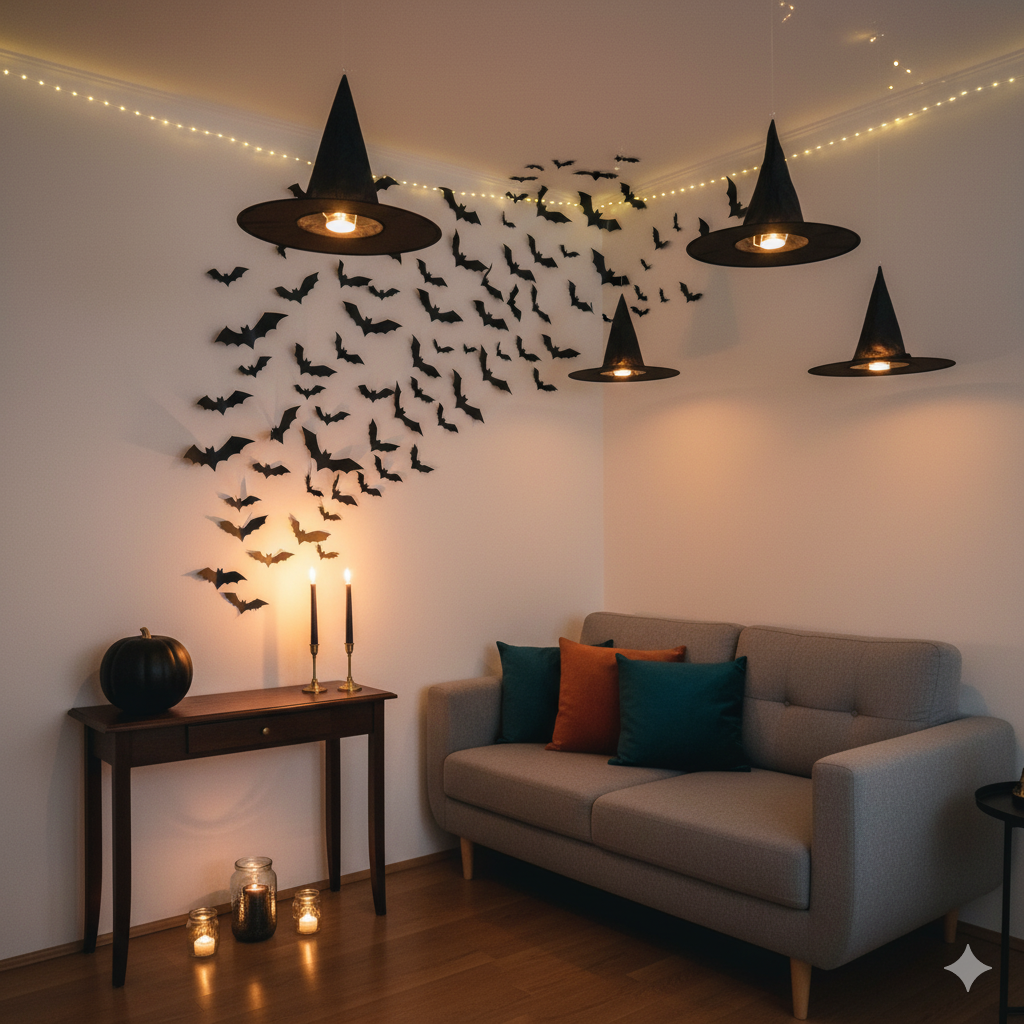
Vertical decorating uses wall height and ceiling space, areas that typically sit empty in apartments, to create dramatic visual effects without consuming floor space. A climbing arrangement of paper bats applied with small adhesive dots moves the eye upward and generates a sense of movement and energy. Floating witch hats suspended from the ceiling on clear monofilament line make a room feel taller and more theatrical. Garlands framing doorways and windows add layered dimension without requiring a single horizontal surface.
The vignette strategy concentrates decor into specific "zones" rather than distributing small items across every surface. A single well-styled vignette on a coffee table — a tiered tray holding a mini pumpkin, a skull candle, and a few black stones — creates more visual impact than the same items spread across three different tables. This approach is particularly effective in studio apartments, where every surface is visible from every other point in the room.
Bookshelf styling is a high-efficiency vignette technique. Existing book spines and everyday objects provide the backdrop, and adding three to five Halloween items — a small cauldron, a ceramic skull, orange taper candles in simple holders — transforms the shelf into a focal point without requiring additional furniture or floor space. The mix of everyday and seasonal items keeps the space from feeling overwhelmed by the holiday.
The visual layering techniques used in vignette decorating connect directly to year-round strategies covered in the resource on making a small space look more spacious and bright.
What Are the Best Room-by-Room Halloween Decorating Ideas for Apartments?
A room-by-room approach prevents the scattered, halfhearted look that results from buying a bag of mixed decorations and distributing them randomly. NRF data shows that 72% of Halloween home decorators focus their spending on the living room and entryway, treating these as the primary public-facing spaces (NRF, 2023). Assigning each room a clear decorating role makes the overall setup feel cohesive and intentional.
The entryway is the first and last impression. A doormat with a Halloween phrase, a wreath hung with an adhesive over-door hook, or a pair of small pumpkins flanking the threshold establishes the holiday tone immediately. For apartments with a shared hallway, the doormat alone is often the only space available, and a well-chosen one does significant work. A door cover poster — attached with removable strips — transforms a plain door into a statement piece for under $15.
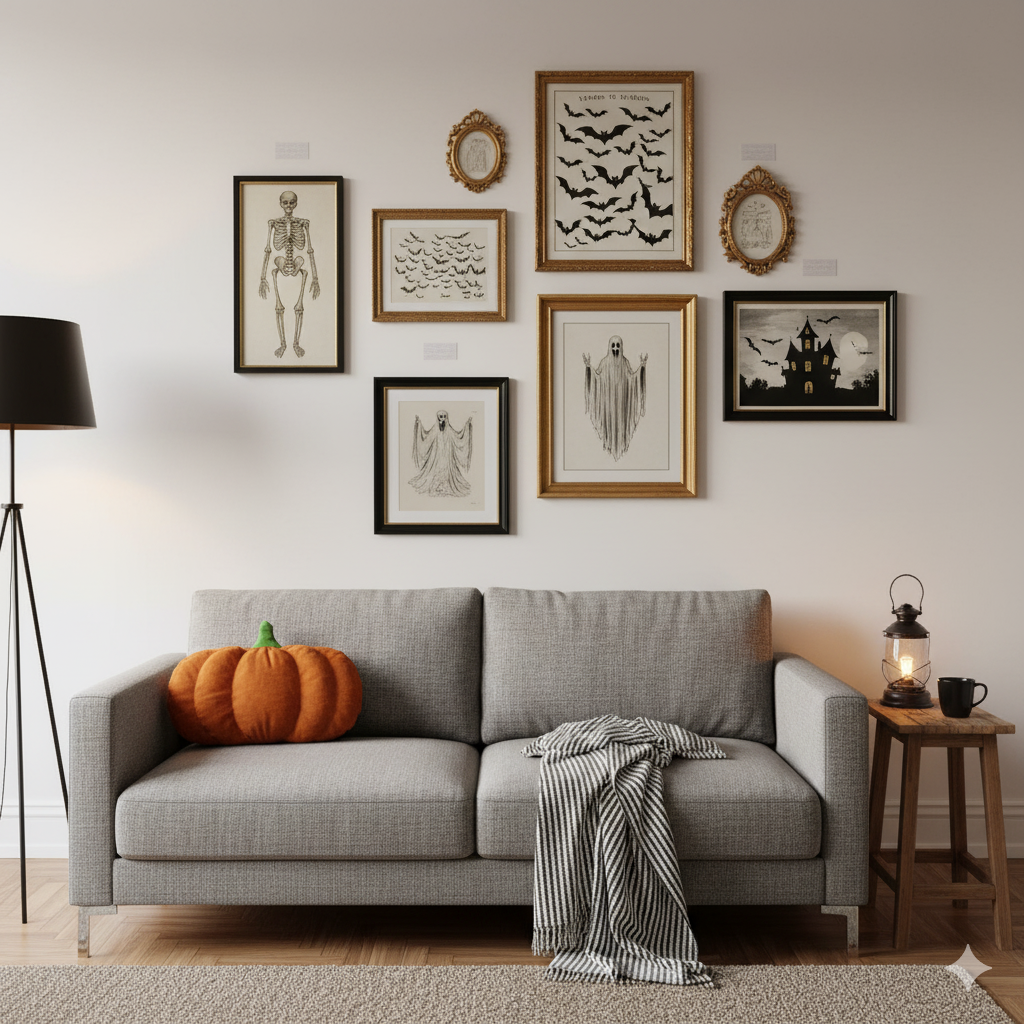
The living room offers the most decorating surface area and the most creative latitude. A fireplace mantel draped with a bat-themed scarf and lined with battery-powered LED candles creates a warm, atmospheric focal point at zero damage risk. Swapping standard art for Halloween prints from print-on-demand services, hung with adhesive picture strips, refreshes the room's personality for the month. A themed throw pillow or two on the sofa adds color without requiring any installation.
The kitchen and bathroom are where functional frights deliver the highest impact per dollar. A skull-shaped soap dispenser, spooky hand towels on a tension-rod towel bar, black paper cups in the bathroom, and a "Psycho"-inspired shower curtain create immersive moments in rooms guests regularly use. These small changes cost $10 to $30 per room and require zero wall modifications.
Balconies and windows serve as the apartment's exterior face. Orange and purple string lights draped along a railing, a full-size skeleton posed in a balcony chair, and window cling silhouettes visible from the street signal the holiday to neighbors and passersby. The skeleton-in-a-chair trend became widely viral in 2020 and remains one of the highest-engagement balcony decorations available at any price point.
How Do You Choose a Halloween Aesthetic That Fits Your Apartment?
A consistent Halloween aesthetic prevents the mismatched, discount-store look that makes decorated spaces feel chaotic. According to NRF trend data, 61% of Halloween decorators in 2023 described their decorating style as "sophisticated" or "curated" rather than "traditional," reflecting a broader shift toward integrated seasonal aesthetics (NRF, 2023). Choosing a style before buying anything narrows decisions and prevents impulse purchases that don't fit the overall look.
Classic Halloween uses a strict black, orange, and white palette with recognizable iconography: carved pumpkins, witches, skeletons, and candy corn. This style works in any apartment because the color combination is visually strong and universally legible. It pairs well with warm wood furniture tones common in rental apartments.
Gothic Romance is moody, elegant, and drama-forward. Key elements include black lace table runners, dripping LED candles, skulls displayed under glass cloches, and antique-style candelabras. This aesthetic functions well year-round with minor additions in late September, making it the most cost-efficient approach for renters who already own dark or neutral furniture.
Spooky-Cute, sometimes called "Pastel Goth" or Halloween Kawaii, mixes pastels — pink, lavender, mint — with black and white. Cute ghost figurines, disco ball pumpkins, and pastel candy-bowl arrangements define this look. It's particularly popular in studio apartments where the owner wants seasonal personality without the apartment feeling dark or oppressive in limited natural light.
Minimalist Macabre focuses on natural elements and a few high-quality statement pieces. Uncarved heirloom pumpkins in varied sizes, bare branch arrangements in tall vases, dried botanicals, and a single dramatic art print characterize this style. It's the lowest-maintenance option and the easiest to pack away after October 31st.
Renter-Friendly Halloween Decor: No Damage, No Deposit Loss
Security deposit protection is the defining constraint of apartment Halloween decorating. The average security deposit in the United States is $1,200, according to data from Apartment List, meaning that a single wall-repair charge for paint damage can erase the equivalent of an entire season's worth of decorating budget (Apartment List, 2023). Understanding which products are genuinely safe — and which are not — prevents expensive mistakes.
Adhesive strips fail most often when applied to surfaces that haven't been properly cleaned, when used in high-humidity areas like bathrooms, or when overloaded beyond their rated weight. Following the manufacturer's removal instructions precisely, pulling the tab slowly at a low angle parallel to the wall rather than pulling outward, prevents the paint lifting that causes most deposit claims. Test a strip in an inconspicuous location before applying it where it will be most visible.
Washi tape is frequently recommended as a renter-safe option, but it behaves unpredictably on painted walls, particularly on walls with eggshell or flat finishes. The adhesive can soften paint if left in place for more than two to three weeks, especially in warm rooms. If washi tape is part of the plan, test it two weeks before full application and check the removal result before committing to a large installation.
String lights are among the safest decorations for renters because they're lightweight, generate minimal heat when LED-based, and hang on adhesive strips without difficulty. Avoid incandescent string lights in enclosed spaces or draped over fabric, as heat accumulation creates both a fire risk and a lease-violation risk. Battery-powered LED candles eliminate the open-flame concern entirely while producing a visually convincing flicker effect.
The most overlooked renter-friendly Halloween strategy is scent. Candles in autumn or Halloween scents — pumpkin spice, sandalwood, oakmoss — create immediate seasonal atmosphere in any room without any visual installation at all. A single well-chosen candle on a coffee table or a wax melt in a plug-in warmer delivers holiday atmosphere in apartments where even adhesive strips feel risky.
Halloween Decor on a Budget: Maximum Impact for Minimum Spend
Halloween decorating doesn't require a large budget to be effective. The NRF reports that the average American household spent $38.47 on Halloween decorations in 2023, yet the NRF's own survey found no meaningful satisfaction gap between households spending under $25 and those spending over $100 on decor (NRF, 2023). The returns on Halloween decoration spending diminish sharply above a certain threshold, which makes DIY and strategic purchasing essential skills.
Paper is the most cost-effective Halloween decorating material available. A package of black cardstock costs under $5 and produces enough paper bats, spider cutouts, or garland shapes to decorate an entire apartment. Gently folding each bat's wings upward along the body centerline creates a three-dimensional shadow effect when applied to a wall, making paper decorations look substantially more expensive than they are.
Cheesecloth ghosts cost approximately $3 to make per ghost using cheesecloth and liquid starch. Draped over a balloon or a hand-shaped form, stiffened with starch, and allowed to dry, they produce a freestanding sculpture that photographs well and works at any scale. Making three or four in graduated sizes and grouping them on a bookshelf or windowsill creates a strong visual impact for under $10 total.
Dollar store pumpkins, skulls, and candle holders provide the foundational objects for most Halloween vignettes at $1 to $3 per item. The key to making dollar-store items look intentional rather than cheap is grouping them by color or finish rather than mixing metallics, matte finishes, and shiny surfaces indiscriminately. A cluster of three matte black skulls reads as a deliberate styling choice; one matte skull, one glitter skull, and one chrome skull reads as random accumulation.
Floating witch hat installations are the most popular budget DIY for apartment Halloween decorating. Inexpensive costume witch hats on clear monofilament line, suspended from adhesive ceiling hooks, create a ceiling-level installation that uses otherwise empty vertical space. Adding a small battery-powered LED tea light inside each hat makes it glow from within, dramatically increasing the visual impact without increasing cost significantly.
Budget allocations that concentrate 60% of spending on two or three statement pieces rather than distributing funds across many small items consistently produce more cohesive, impressive-looking apartments. A $40 statement item — a large ceramic skull, a quality wreath, a multi-light candelabra — anchors a room's aesthetic in a way that $40 spread across twelve $3 items rarely achieves.
The Witching Hour Is DIY Hour: 3 Projects That Use Vertical Space
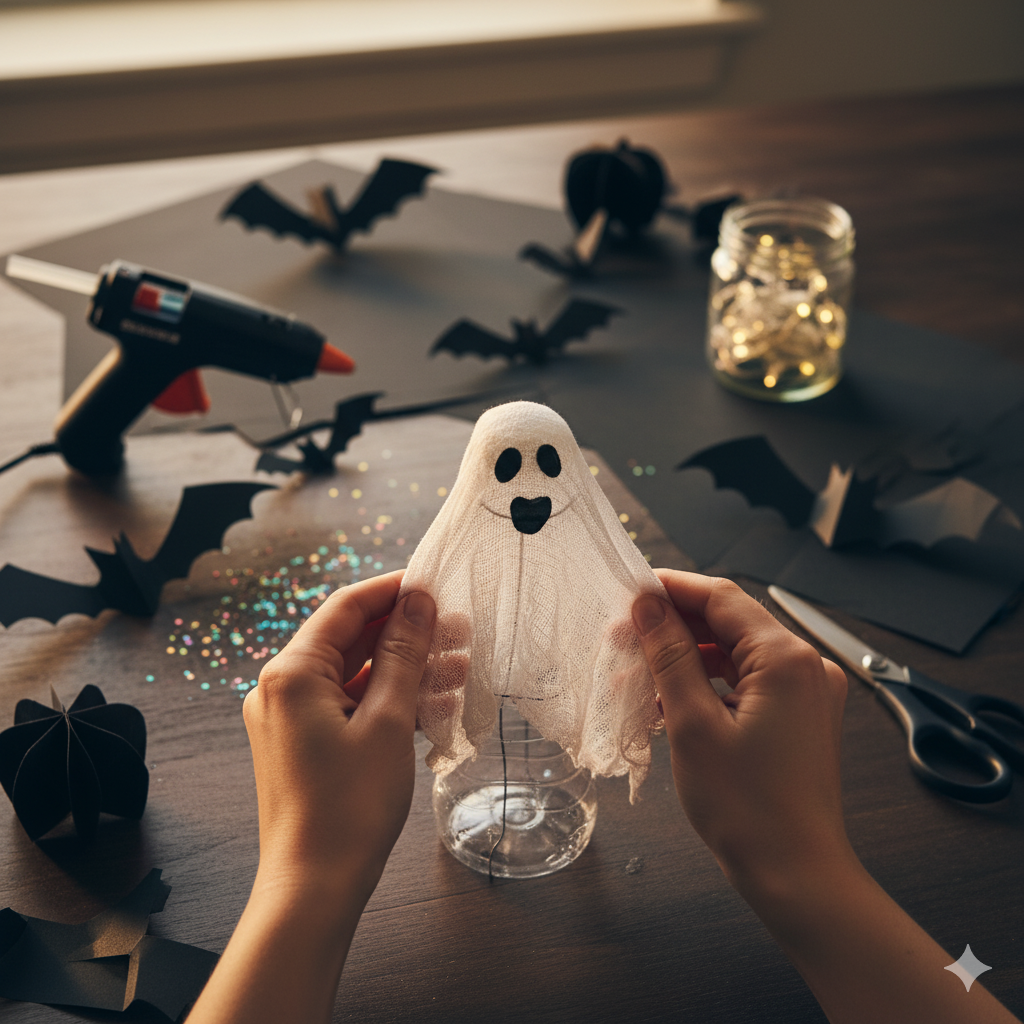
DIY projects offer the best return on time investment in apartment Halloween decorating because they're customizable to exact color palettes and size constraints. NRF consumer research found that 43% of Halloween decorators made at least one DIY decoration in 2023, up from 31% in 2019, driven largely by apartment-dwelling millennials seeking damage-free options (NRF, 2023).
-
Floating Witch Hats: Thread monofilament line through the top of inexpensive costume witch hats. Attach adhesive ceiling hooks rated for at least one pound. Drop the hats at varied heights across a living room or hallway ceiling. Add a small LED tea light inside each hat for a soft internal glow. The entire project costs under $20 for five hats and installs in under 30 minutes.
-
Cheesecloth Ghosts: Cut cheesecloth into 24-inch squares. Mix one part white school glue with two parts water. Dip the cheesecloth, drape it over an inflated balloon, and allow it to dry fully for 12 hours. Pop and remove the balloon. Draw simple eyes with a black marker. The resulting rigid ghost stands independently on any surface and costs under $2 per ghost to produce.
-
3D Paper Bat Swarm: Print or freehand-cut bat shapes from black cardstock in three sizes: small (3 inches), medium (5 inches), and large (7 inches). Score the center of each bat's body and fold the wings slightly upward to create dimension. Apply with small adhesive dots in a climbing formation up a wall corner, mixing sizes for scale variation. The entire swarm — 30 to 40 bats — costs under $5 and leaves no marks.
How Do Sights, Sounds, and Scents Complete an Apartment Halloween Setup?
Atmospheric elements transform a visually decorated apartment into an immersive Halloween experience. Research in environmental psychology shows that multisensory environments are remembered 70% more vividly than visually-only environments, making scent and sound investments particularly effective for creating a genuinely memorable holiday space (APA, 2020). In a small apartment, where visitors experience every element within a few feet, these details register immediately.
Lighting is the most powerful atmospheric tool in a small space. Swapping standard white bulbs for color-changing smart bulbs allows the apartment's existing fixtures to produce deep orange, purple, or green tones on demand. Battery-powered LED candles create a convincing flicker without open-flame hazards or lease violations. String lights in warm amber tones draped across a bookshelf or around a window frame shift the entire room's mood without requiring a single structural change.
Sound design requires minimal investment for maximum effect. A curated Halloween playlist running through a Bluetooth speaker placed inside a hollow pumpkin prop creates a muffled, eerie audio effect that delights guests. For family-friendly gatherings, classic Halloween sound effects — creaking doors, distant thunder, owl calls — play well as background ambiance. For adult parties, a more curated mix of dark electronic music or film scores from Halloween and Suspiria sets a sophisticated atmospheric tone.
Scent is the most underestimated atmospheric element in apartment Halloween decorating. Candles or wax melts in autumnal or gothic scent profiles — pumpkin spice, smoked wood, black amber, dried botanicals — activate memory and mood associations that visual decor alone cannot produce. Positioning a scented candle near the apartment entrance ensures that guests register the holiday atmosphere within seconds of walking in, before they've even looked at a single decoration.
Frequently Asked Questions About Decorating an Apartment for Halloween
How do you hang Halloween decorations in an apartment without damaging walls?
Adhesive strips and hooks designed for temporary use, such as those from the Command product line, allow hanging lightweight decorations without nails or screws. Match the strip's weight rating to the item being hung and always clean the wall surface before application. The NRF notes that 69% of apartment Halloween decorators rely on adhesive-based tools as their primary hanging method (NRF, 2023). Tension rods in doorways handle heavier fabric drapes without any wall contact at all.
What are the best Halloween decorations for a small apartment?
Vertical decorations and vignette-style tabletop arrangements work best in small apartments because they create visual impact without consuming floor space. Floating witch hats on monofilament line, wall-climbing paper bat swarms, and styled tiered trays on coffee tables deliver high visual payoff in tight quarters. The NRF reports that the average apartment decorator spends $38.47 on Halloween decor annually (NRF, 2023), a budget that stretches furthest when concentrated into two or three well-chosen focal points.
Can you decorate a rented apartment for Halloween without losing your security deposit?
Yes — with the right products and correct application technique. Adhesive strips, tension rods, window clings, and removable fabric fasteners leave no permanent marks when used as directed. The critical step is removing all adhesives before the lease end date and following the manufacturer's removal method precisely. The average U.S. security deposit is $1,200 (Apartment List, 2023), which makes understanding proper adhesive removal technique one of the highest-value skills a renter can develop for seasonal decorating.
How do you decorate an apartment for Halloween on a tight budget?
Paper crafts, dollar store groupings, and a single statement piece constitute the most cost-efficient approach. Black cardstock bats, cheesecloth ghosts, and dollar store skulls grouped by finish level produce results that look deliberately styled rather than budget-constrained. Allocating 60% of the decorating budget to one or two anchor items — a quality wreath, a large ceramic skull, or a multi-light candelabra — and spending the remainder on DIY materials maximizes visual return per dollar. NRF data confirms that spending and satisfaction are not meaningfully correlated above the $25 threshold (NRF, 2023).
What Halloween decor ideas work best for studio apartments?
Studio apartments benefit most from single-zone focus and multisensory elements that work independently of visual density. A single strongly decorated vignette on the main bookshelf or coffee table, ceiling-hung witch hats to use vertical space, and a Halloween-scented candle near the entrance create a complete seasonal atmosphere without making a single room feel cluttered. For year-round small-space strategies that apply directly to seasonal setups, the guide to studio apartment decor covers layout and focal-point principles in detail. NRF data shows studio-apartment dwellers report equal holiday satisfaction to homeowners despite smaller budgets and spaces (NRF, 2023).
Final Thoughts on How to Decorate an Apartment for Halloween
Decorating an apartment for Halloween is a solvable problem, not a compromise. The tools exist, the techniques are straightforward, and the results are achievable at any budget. Americans invested $3.9 billion in Halloween home decor in 2023 (NRF, 2023) because a well-decorated space genuinely improves the holiday experience — and apartment renters participated fully in that investment, using damage-free methods that protect deposits while delivering real atmosphere.
The strategies in this guide build on each other. Start with the damage-free toolkit, then select an aesthetic, then work room by room from the entryway inward. Add DIY projects where budget is tight and statement purchases where they'll anchor the overall look. Finish with scent and sound, which complete the experience that visual decor alone cannot deliver.
For the spatial and lighting principles that make small apartments feel more open year-round, the resource on making a home look more spacious and bright provides the foundational techniques that seasonal decorating builds upon.
More from Studio & Small Apartment
Layout, decor, and life in studio and small apartments.
How Do You Decorate a Studio Apartment?
Wondering how to furnish your studio apartment without it feeling cramped? This guide answers your questions with smart ideas for zoning, furniture, and deco...

How to Decorate a Studio Apartment: An Expert's Guide
8 min read
How Do You Decorate a Studio Apartment?
10 min read

The Art of Studio Living: Your Complete Guide
10 min read
How to Layout a Small Apartment?
25 min read

3 Flawless Layouts and 5 Real-Life Studio Solutions
21 min read
How Do You Decorate a One-Bedroom Apartment?
18 min read
Tags

Written by Joesp H.
Interior Design & Small Space Living Specialist
Former marketing manager turned full-time home optimizer. After living in 7 homes ranging from 450 to 2,000 sq ft, I started CleverSpaceSolutions to help people create organized, functional spaces on real budgets.
Other Articles
How to Decorate a Studio Apartment for Halloween?
Wondering how to decorate your studio for Halloween without the clutter? This guide answers with renter-friendly, space-saving ideas for a big impact.
How Do You Decorate a Small Space for Halloween?
Wondering how to decorate your small apartment or room for Halloween? This guide answers with clever, space-saving ideas for walls, lighting, and DIY projects.
How Do You Decorate a Dorm Room for Halloween?
Want to decorate your dorm for Halloween without damage? This guide answers with renter-friendly hacks, budget DIYs, and stylish ideas for a spooky space.