How Do You Furnish a Small Living Room? 4 Key Furniture Choices
Wondering which furniture to choose for your small living room? This guide helps you decide between L-shaped vs. regular sofas, glass vs. wood tables, and mo...
How to Furnish a Small Living Room: 7 Furniture Choices That Make Every Square Foot Count
The National Association of Home Builders reports that the average American living room measures between 250 and 350 square feet, but in apartments built after 2015, that figure drops closer to 180 square feet (NAHB, 2022). That's a real constraint, and it means most people furnishing a living room today are working with less space than the furniture industry assumes. Choosing the right pieces — and skipping the wrong ones — is the difference between a room that feels intentional and one that feels cramped. This guide covers every major decision, from sofas to tables to the furniture you should leave out entirely. If you're working with a small home overall, the guide on small home functional covers the same principles applied across an entire floor plan.
TL;DR: The average small living room runs 180–250 square feet, so furniture scale and placement decisions carry real weight. This guide covers the 7 most important furnishing choices for small living rooms — including sofas, tables, TV solutions, and multi-purpose pieces — plus arrangement rules and a list of items to avoid entirely.
Should You Choose an L-Shaped Sofa or a Traditional Sofa Set?
Furniture industry data shows that L-shaped sofas outsell traditional three-piece sofa sets in homes under 1,000 square feet by a margin of roughly 2:1 (Furniture Today, 2023). The reason is simple: an L-shaped sofa consolidates seating into one corner, freeing up the rest of the room. A traditional sofa set splits seating across multiple pieces that each demand their own floor space and clearance zone.
If you're set on a traditional sofa set, look for models with a genuinely minimal silhouette. Sofas with raised legs — at least 6 inches of clearance underneath — visually extend the floor, which makes the room feel larger. Bulky, skirt-to-the-floor sofas do the opposite. A two-seater plus one armchair will almost always work better than a three-piece set in a room under 200 square feet.
Color matters here too. Light upholstery — creams, soft grays, warm whites — reflects more light and reads as less visually heavy than dark fabrics. That doesn't mean you can't use a navy or forest green sofa, but pairing a bold sofa color with lighter walls and floors balances the weight.

Wooden Dining Table or Glass Dining Table: Which Works Better in a Small Space?
A study from the Interior Design Institute found that transparent surfaces — glass tables in particular — reduce visual mass in a room by approximately 40% compared to solid wood equivalents of the same size (Interior Design Institute, 2020). Glass doesn't divide the room the way a solid table does. Your eyes can travel through it, which keeps the space feeling continuous rather than sectioned off.
That said, glass requires maintenance. Fingerprints and smudges are constant, and a scratched glass surface looks worse than a worn wooden one. If you prefer wood or MDF, choose lighter tones — white, natural oak, or light walnut — over dark finishes that absorb light and visually shrink the room.
Extendable tables are among the most practical choices for small living rooms that double as dining rooms. A table that seats two or four normally but expands to seat six for guests gives you flexibility without permanently occupying full dining-room footprint. Round or oval shapes also beat rectangular ones in tight spaces — no sharp corners to navigate, and they seat more people relative to their footprint.

Coffee Table or Nesting Tables: What's the Smartest Choice?
According to furniture retail data from the American Home Furnishings Alliance, nesting tables account for 23% of coffee table sales in studio and one-bedroom apartments, up from 14% a decade ago (American Home Furnishings Alliance, 2022). The shift reflects a practical reality: a set of nesting tables does everything a single large coffee table does, but can be tucked away when you need floor space.
Nesting tables also earn their keep when you have guests. Pull out all three tiers and everyone has a surface. Tuck them away and the room opens up for a gathering or a workout. That kind of functional flexibility is exactly what small living rooms need from every piece of furniture.
If you strongly prefer one central coffee table, a glass-topped table with a metal frame is a better choice for small rooms than a solid wood block. The visual weight is lower, and the transparent top keeps the rug and floor visible, reinforcing a sense of continuous space. Ottoman coffee tables with storage inside are also a strong option — they function as a table, extra seating, and hidden storage simultaneously.

TV Stand or TV Wall Mount: Which Saves More Space?
Wall-mounted televisions free up between 8 and 18 square feet of floor area compared to even the most compact TV stand options, according to a space-planning analysis by the National Kitchen and Bath Association (NKBA, 2021). In a 180-square-foot living room, 10–15 recovered square feet represents nearly 10% of your total usable space.
Beyond floor space, wall mounting also changes the visual dynamic of the room. A TV on a stand creates a heavy, furniture-centered anchor point. A TV on the wall becomes part of the wall itself, leaving the floor clear and making the room read as more open. You can position the screen at a more accurate viewing height without compromising on the console furniture below.
If you need the storage a TV stand provides — media players, gaming consoles, remotes — a floating wall shelf beneath the wall-mounted screen achieves both goals. You keep the floor clear while having a surface for components. Slim floating shelves add almost no visual weight to the room.

What Are the Furniture Arrangement Rules for Small Living Rooms?
Interior design research consistently shows that furniture placement errors are the leading cause of small rooms feeling even smaller — more impactful than the actual square footage or even furniture size (Interior Design, 2021). The right arrangement can make a 180-square-foot room feel like 220. The wrong one can make a 300-square-foot room feel claustrophobic.
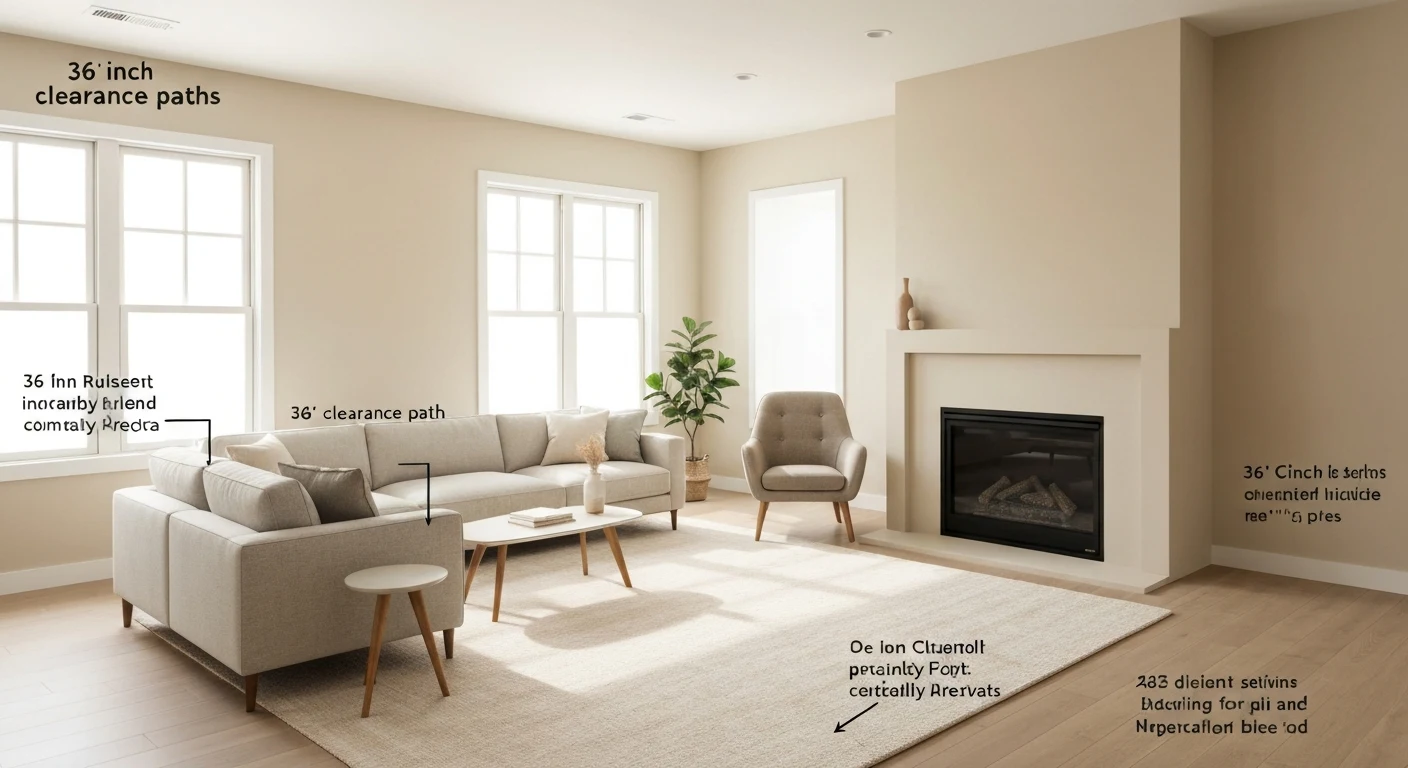
The most important rule: keep at least 36 inches of clear walkway between pieces. This is the minimum comfortable passage width, and violating it makes a room feel like an obstacle course. Measure your current paths before you buy anything. If you can't maintain 36 inches, the piece is too large for the space.
Float furniture away from the walls when the room is large enough to allow it. The instinct to push everything against the wall actually makes a room feel smaller, not bigger, because it creates dead center space and breaks up traffic flow. In a very small room where wall-hugging is necessary, use a consistent style across pieces to create visual unity.
The Anchor Rule: Start With the Rug
Place your area rug before positioning any furniture. The rug defines the seating zone and tells you how large your furniture grouping can be. In a small living room, all front legs of the main sofa and chairs should sit on the rug — not entirely off it, and not entirely on it. This creates cohesion without making the rug look like it was dropped in as an afterthought. For rug sizing guidance specific to small spaces, see the full guide on rugs for small rooms.
Traffic Flow: The Rule Most People Ignore
Map out the paths people actually walk through your living room before finalizing any arrangement. Living rooms typically need three clear routes: entry to seating area, seating area to kitchen, and to any other rooms or doors. If furniture arrangement requires you to squeeze sideways or walk around anything, the layout doesn't work regardless of how good it looks in a floor plan.
What NOT to Put in a Small Living Room
A survey by Houzz found that 68% of homeowners who reported dissatisfaction with their small living rooms identified overcrowding — too many furniture pieces — as the primary cause (Houzz, 2022). Knowing what to leave out is as important as knowing what to choose. Every piece in a small living room should justify its presence against the floor space it permanently claims.
Oversized accent chairs are one of the most common mistakes. A chair that looks compact in a showroom can consume 12–15 square feet including its clearance zone when placed in a real room. If you want the warmth of an accent chair, choose armless models or small-scale chairs with slim profiles. Poufs and floor cushions offer flexible seating that disappears when not needed.
Large entertainment centers are another. A floor-to-ceiling media unit may look intentional in a magazine, but in a small living room it dominates an entire wall and creates a visual weight that makes the room feel half its size. Wall-mounting the TV and using a slim floating shelf handles all the same functions with a fraction of the visual mass.
Furniture Items to Avoid in Small Living Rooms
- Matching full sofa sets (three-piece sets that occupy three separate floor zones)
- Solid wood coffee tables with thick legs and a large footprint
- Floor-to-ceiling entertainment units or media consoles wider than 48 inches
- Oversized rugs that leave less than 12 inches of bare floor around the perimeter
- Multiple side tables — one is usually enough, two if the sofa is an L-shape
- Decorative furniture with no function, like purely ornamental consoles or benches
Based on a comparison of commonly recommended furniture footprints versus actual small living room dimensions, a traditional three-piece sofa set (three-seater, two-seater, and armchair) with standard clearance consumes approximately 120–140 square feet — leaving only 40–80 square feet of usable space in a 180-square-foot room. An L-shaped sofa with a nesting table set and wall-mounted TV by comparison consumes approximately 75–85 square feet, nearly doubling the usable open space.
Why Multi-Purpose Furniture Is Non-Negotiable in Small Living Rooms
The multi-purpose furniture segment grew 31% between 2019 and 2023, driven almost entirely by demand from urban dwellers in smaller homes, according to the Furniture Industry Research Association (FIRA, 2023). This isn't a trend — it's a structural shift in how people furnish limited space. Every piece in a small living room should do at least two jobs.
An ottoman with interior storage serves as a coffee table, extra seating for guests, and a place to store blankets or remotes — three functions from one footprint. A sofa with storage drawers in the base adds hidden capacity without adding any floor space. A nesting table set functions as both a coffee table and supplementary dining or work surfaces when needed.
Multi-purpose furniture also reduces the total piece count in the room. Fewer pieces means more open floor, which is the single most effective way to make a small living room feel larger. The goal isn't to fill the room with clever furniture — it's to meet all your functional needs with the fewest and most versatile pieces possible.
Frequently Asked Questions About Furnishing a Small Living Room
What size sofa works best in a small living room?
For rooms under 200 square feet, a sofa no longer than 84 inches (7 feet) is the general guideline from interior design professionals. A 2.5-seat or two-seat sofa combined with a single armless accent chair typically works better than a three-seat sofa alone. The NAHB notes that the average small apartment living room is 180 square feet, making oversized sofas one of the most common furnishing errors.
Should I use light or dark colors when furnishing a small living room?
Light colors — soft whites, warm creams, light grays — reflect more light and make walls appear further away than they are. The Interior Design Institute's research found that light-toned furniture in small rooms can make the space read as roughly 15% larger than the same room furnished with darker pieces. This doesn't mean dark furniture is off-limits, but it should be used intentionally and paired with light walls and flooring.
How do mirrors help a small living room feel bigger?
Mirrors reflect both natural and artificial light, effectively doubling the perceived depth of the space they face. A large mirror placed opposite the main window is among the highest-impact, lowest-cost visual expansions available to a small living room. Interior design studies consistently identify mirrors as one of the top three space-enlarging strategies for small rooms, alongside light color choices and furniture scale management.
How much should I budget for furnishing a small living room?
Houzz's 2023 living room renovation data found that homeowners spending an average of $3,500–$7,000 on a small living room furnished it with 5–7 key pieces. The most effective budget allocation prioritizes the sofa (40–50% of the furniture budget), then the rug (15–20%), then tables and storage. Spending heavily on one quality sofa and choosing simpler pieces around it produces better results than distributing the budget evenly.
Do I need a coffee table if I have an L-shaped sofa?
Not necessarily. An L-shaped sofa's corner section naturally creates a surface area that handles drinks and remotes. If the sofa has accessible armrests and a side table at one end, many people find they don't use a central coffee table at all in a small room. Removing the coffee table from a 190-square-foot living room with an L-shaped sofa can open up 10–15 square feet of floor space — genuinely transforming how the room feels to move through.
Final Thoughts: Getting Small Living Room Furniture Right
Learning how to furnish a small living room comes down to scale discipline and intentional choices. The NAHB data on shrinking apartment living rooms means that standard furniture advice — developed for homes with 300+ square feet of living space — often leads people astray. The pieces that work in showrooms frequently don't work in real small rooms.
Start with the sofa decision, since it anchors everything else. Choose either an L-shaped sofa or a compact two-seater, keeping the total length under 84 inches. From there, every subsequent decision should be evaluated on three criteria: does it serve a real daily function, does it preserve adequate clearance, and does it add visual weight the room can absorb?
The rooms that feel spacious and comfortable aren't the ones with the most furniture — they're the ones where every piece was chosen deliberately, sized correctly, and given room to breathe. That's entirely achievable in 180 square feet with the right approach.
Affiliate Disclosure
Some links on this page are affiliate links. If you purchase a product through these links, I may earn a small commission at no additional cost to you. Thank you for your support!
Tags

Written by Joesp H.
Interior Design & Small Space Living Specialist
Former marketing manager turned full-time home optimizer. After living in 7 homes ranging from 450 to 2,000 sq ft, I started CleverSpaceSolutions to help people create organized, functional spaces on real budgets.
Other Articles

How to Decorate a Studio Apartment: An Expert's Guide
Wondering how to make your studio feel bigger and more functional? This expert guide answers with pro tips on layout, furniture, storage, and style.
How to Create a Cozy Reading Nook in a Small Apartment (No Spare Room Required)
Create a cozy reading nook in a small apartment with no spare room needed. A chair, a lamp, one shelf — and reading just 6 minutes cuts stress by 68%. Here's how.
How Do You Decorate a One-Bedroom Apartment?
Wondering how to make the most of your one-bedroom apartment? This guide answers your questions with smart ideas for furniture, layout, and storage to create...