Small Balcony Privacy Ideas: How to Block Out Neighbors and Build a Private Outdoor Retreat
25 renter-friendly small balcony privacy ideas: bamboo screens, plant walls, outdoor curtains, pergolas. Block neighbors, dampen noise, stay HOA-compliant.
TL;DR: Small balcony privacy is a four-sightline problem (above, below, sides, front), not one wall to block. Layer three things: a tall visual screen (bamboo roll-up, outdoor curtain, or plant wall), a medium privacy element (climbing trellis, sail shade, or pergola), and a sensory cover (warm string lights and a small water feature). Renter-friendly setups for a 50 to 70 sq ft balcony start at $80 and top out around $700, well below the $3,500 to $9,500 a contractor charges for a retractable privacy screen install (Angi 2026 cost data). Pinterest searches for "balcony makeover ideas" jumped 165% heading into 2026, so this is the moment to build it.
My first apartment with a real balcony was on the fifth floor of a courtyard building, and the neighboring balcony sat exactly 12 feet away. Every morning coffee, every evening dinner, every phone call I took outside, I felt the same thing: someone was always within glance distance. The balcony was technically mine. Practically, it was a fishbowl. If you have ever felt that and then retreated back inside, this guide is for you. Privacy is the difference between a balcony you avoid and a balcony you actually live on.
Small balconies are now standard in modern American apartments. The U.S. delivered roughly 612,000 multifamily units in 2024, the highest one-year total in 38 years (NAHB, July 2025), and the National Apartment Association notes that today's apartment balconies typically run 32 sq ft for studios up to 65 sq ft for a one-bedroom. Newer buildings push that to about 70 sq ft, what the industry calls "the go-to living space." That sounds tiny on paper. In my experience it is plenty, but only once you solve the privacy problem first. For the broader balcony playbook (plants, food gardening, container choice), my small balcony garden ideas guide is the companion piece. This article focuses on one job: blocking sightlines so you can actually use the space.
The demand here is no longer niche. A 2024 Greystar renter preference study reported by Multi-Housing News found that 45% of U.S. renters list private outdoor space as a non-negotiable amenity (58% for renters 65 and older), and Pinterest's 2026 trend report flagged "balcony makeover ideas" as up 165% year over year. Over the next 3,500 words I will walk you through the four sightlines you have to address, the renter-friendly tools that actually work, the plant species that grow fastest, the wind and HOA constraints that can sink a project, and four full recipes by budget so you can pick the version that fits your life. Every recommendation is grounded in real research or live cost data, and I will flag the renter-safe option at every step.
Why Balcony Privacy Is the Most Searched Outdoor Project of 2026
Balcony privacy is not a vanity project. It is a stress-management asset, and the data here is finally strong enough to stop arguing about it. A July 2025 meta-analysis of 78 field experiments published in Nature Cities found that brief 10 to 30 minute exposures to urban nature produced measurable reductions in stress, anxiety, and depressive symptoms, with cortisol drops up to 21%. The catch is that you have to actually go out there. A balcony you avoid because you feel watched delivers zero of that benefit, no matter how nice the view is.
The macro behavior backs it up. The U.S. Bureau of Labor Statistics' American Time Use Survey 2024 (released June 2025) found that Americans 15 and older spend an average of 5.1 hours per day on leisure and sports, with 94% engaging in leisure daily. Some of that lives on a balcony if the balcony works. None of it does if the balcony feels exposed. The market is responding: Grand View Research valued the U.S. outdoor living structures market at $892.9 million in 2024, growing at 5.3% per year to $1.22 billion by 2030. People are not just buying outdoor furniture, they are buying the structural elements that make outdoor furniture feel safe to use.
The Pinterest signal is even louder. Searches for "balcony makeover ideas" rose 165% year over year heading into 2026 (Pinterest Spring 2026 Trend Report), and "garden inspiration ideas" surged 940%. Your search history is not unusual. A few million people are working on the same project right now. If you want to push the privacy retreat into actual hosting territory, my guide to hosting in a small outdoor space covers the layout side; this article makes sure your guests are not on display while it happens.
The Privacy Audit: Where Are You Actually Exposed?
Most balcony privacy projects fail because they treat privacy like it is one wall. It is not. On a typical apartment balcony you have four sightlines, and each one needs a different fix. Skip the audit and you end up with a beautiful bamboo screen on the rail while your upstairs neighbor watches you eat dinner. I have seen that mistake at least 20 times.
The four sightlines, in the order I rank them by how often they actually bother people:
- From above (upstairs neighbor or building setback). This is the worst because you cannot avoid it by adjusting where you sit. Solved by a pergola, sail shade, awning, or tall climbing-plant frame.
- From the side (adjacent balcony). Solved by a side wing screen, a tall planter wall, or a curtain pulled to one side.
- From the front (facing building or street). Solved by the railing-line tools: bamboo roll-up screen, reed fence, opaque outdoor fabric panel.
- From below (downstairs neighbor or street level looking up). Usually the least urgent. Solved by floor-line planters or a low-skirt fabric.
Spend 15 minutes doing the audit before you buy anything. Sit in each spot you actually use (the chair, the dining seat, the standing-by-the-rail spot) and look out and up. Have a friend stand on the upstairs balcony, or just glance up and notice angles. Photograph each sightline so you can plan against the actual problem instead of the imagined one. In my fifth-floor apartment, the audit revealed that the front-of-building view was barely an issue (we were five floors up and angled away from the street), but the side-to-side adjacent balcony was the real culprit. I wasted $90 on a railing screen before I figured that out.

One more honest note: you almost never need to block all four sightlines fully. Total enclosure makes a balcony feel like a closet. The goal is enough cover that you stop noticing the exposure, not a tactical bunker.
Renter-Friendly Privacy Screens (Bamboo, Reed, and Outdoor Fabric)
The cheapest and fastest privacy fix is a screen attached to your existing railing. The global privacy screens market is projected to grow from $250 million in 2025 to $443.5 million by 2035 (Fact.MR, 2025), and almost all of that growth is in the consumer roll-up category that costs less than $200 and installs without permanent damage. Three formats matter for renters:
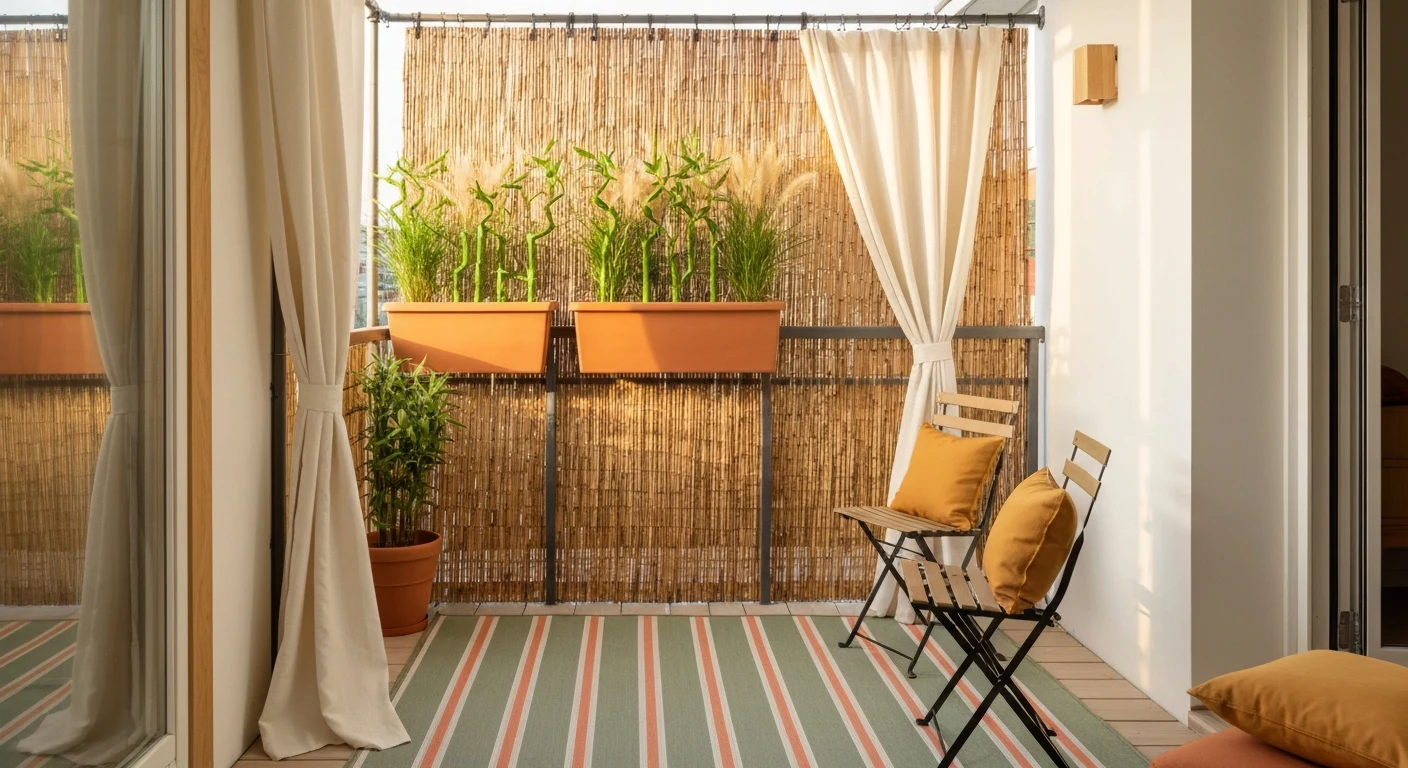
- Bamboo roll-up screens. A 6 ft by 6 ft natural bamboo screen runs $30 to $80 at major hardware retailers. Attach with black UV-rated zip ties through the existing railing balusters, four ties per panel minimum. The bamboo softens the look of any railing and reads as intentional even on bare metal. Expect 2 to 3 seasons of life outdoors before sun bleaches it.
- Reed (willow or peeled reed) fencing. Tighter weave than bamboo, around $40 to $120 per 6 ft section. Better for breeze flow on windy balconies because the gaps between reeds reduce sail effect. Attach the same way.
- Outdoor fabric privacy panels. HDPE mesh panels with brass grommets every 18 inches, $25 to $90. Designed specifically for balcony rails, sold in earth tones (sand, sage, navy, charcoal). The mesh blocks 70 to 90% of visibility while letting wind through, which is critical above the third floor where solid panels become sails.
Two installation rules I have learned the hard way. First, drop the panel an inch below the top of your railing if you can. Most renters mount flush with the top, which still leaves your head visible from the side. Dropping it gives you full coverage when you sit and only a head silhouette when you stand, which is the right tradeoff for most balconies. Second, double up your zip ties on the windward corner. Wind hits the top corners hardest, and a single zip tie there will fail in a storm. For other no-damage attachment ideas you can adapt to a balcony, my renter-friendly wall decor guide covers the broader playbook of mounting things without drilling.

The Plant Wall: Living Privacy That Looks Better Than a Fence
If you only do one privacy upgrade, make it a plant wall. Plants double as decor, soften every other element on the balcony, and the noise dampening is real, not vibes. A peer-reviewed study by Wong et al. published in Building and Environment measured vertical greenery systems and found a weighted sound reduction index of 15 dB. A 2025 follow-up in the Journal of Building Acoustics found that Virginia creeper (Parthenocissus quinquefolia) leaves reduce sound pressure level by up to 20 dB in mid frequency ranges. Translated: a wall of leaves does not just hide you, it quiets the conversation drifting from the next balcony.
The plant market is booming for exactly this reason. The National Gardening Association's 2024 National Gardening Survey reported a record $52.3 billion in spending across 122.3 million U.S. households, with 80% of households participating in lawn and garden activities, a five-year high. Most of those households do not have a yard. Container plants on balconies and patios are absorbing the spending.
For a small balcony privacy plant wall, here is the layered formula I use:
- Tall back row (6 to 8 ft). Lucky bamboo (Dracaena), feather reed grass (Calamagrostis), bamboo palms, or potted golden bamboo. Bamboo grows fastest of any plant on earth: certain species hit 91 cm of growth in a single day according to the Guinness World Records reference for Phyllostachys reticulata in Kyoto, June 1955. Even slower-growing potted varieties give you 4 to 6 ft of height in one season.
- Mid row (3 to 4 ft). Compact ornamental grasses, tall lavender, rosemary in 30L pots, dwarf hibiscus.
- Front row (1 to 2 ft). Trailing varieties that spill over the planter edges: ivy, sweet potato vine, trailing petunia, creeping jenny.
The visual trick is to plant in odd numbers (3 or 5 large pots, not 4) and to mix at least two leaf textures: a fine-textured plant like grass or lavender against a broader-leaf plant like canna lily or fatsia. For full plant selection logic including sun, shade, and wind tolerance for balconies specifically, the small balcony garden guide goes deeper. For why bringing nature indoors and outdoors changes how a small space feels, my biophilic design guide for small apartments walks through the wellness side.

Plant weight is the only real constraint. Most residential balconies handle 150 to 300 kg per square meter (verify with your building management), which means a row of five 30-liter terracotta planters fully watered weighs about 200 kg total and lives well within limits if spread along the rail rather than concentrated in one corner. Resin or fiberglass pots cut that weight by half if you are anywhere close to the limit.
Outdoor Curtains: The Romantic Wraparound Solution
Curtains are the most-underused balcony privacy tool, and they are the one I recommend most often for couples who want the space to feel like an extension of the bedroom rather than a tactical screen. The setup is simple: tension rod or freestanding curtain rod across the open side of the balcony, two to four panels of outdoor-rated fabric, tie-backs for when you want the view open. Done.
The fabric matters more than the rod. Two options:
- Sunbrella outdoor canvas. $35 to $80 per panel, 7 to 10 year UV life, mildew resistant, holds up to rain. The premium option.
- Polyester outdoor curtain panels. $15 to $35 per panel, 2 to 4 year life. Acceptable if you accept replacing them periodically.
Avoid indoor cotton or linen on a balcony unless you bring them in every night. Outdoor moisture, sun, and pollen will destroy them within one season, and you will end up with mildew streaks at the bottom hem regardless of how often you wash them. I made this mistake on my second balcony with a set of $200 linen drapes that lasted six weeks.

Two practical tricks. Use weighted hems (sandbag weights or sew lead tape into the bottom) so the panels stay put in light breeze. And install on a continuous tension rod corner-to-corner so you can pull the curtains back to one side completely, opening the view. Curtains that only slide halfway feel claustrophobic; curtains that fully retract feel like a choice.
Vertical Trellises and Climbing Plants for Long-Term Privacy
If you plan to stay put for more than two years, a trellis-and-climber combination is the highest-quality long-term privacy you can build on a balcony, and the cost-per-year is the lowest of any solution. A freestanding metal trellis ($60 to $150) plus three climbing plants ($30 to $60 total) gives you a living wall that grows denser and prettier every year while every fabric or screen solution degrades.
The plant matters. My ranking for balcony climbers from fastest to slowest:
- Star jasmine (Trachelospermum jasminoides). Evergreen, fragrant, 4 to 6 ft per year once established, partial shade tolerant. The single best balcony climber if your zone supports it (USDA 8 to 10).
- English ivy (Hedera helix). Evergreen, 3 to 8 ft per year per the Royal Horticultural Society growing guide, partial shade tolerant. Aggressive grower, will need pruning. Avoid if you have a wood balcony rail (it can grip and damage paint).
- Climbing hydrangea. Slow start (year one and two are quiet), but year three forward delivers spectacular coverage and white summer blooms. Patient option.
- Annual sweet pea or morning glory. Reach 6 to 8 ft in one season. Re-plant from seed each spring. Cheapest entry point.
- Climbing rose. Beautiful, but requires a sturdy trellis and full sun. More effort than ivy or jasmine.
Set the trellis 4 to 6 inches off the wall or railing so air can flow behind the foliage. Plants pinned flat against a wall develop mildew. Anchor the trellis to a heavy planter base ($30 to $80 for a 50L round terracotta or fiberglass planter) so it does not tip in wind. Train the vines weekly with twine for the first month, then they self-attach. Within two seasons you will have a lush, fragrant, sound-absorbing privacy wall that costs less per year than a single roll-up screen and looks ten times better.
Pergolas and Shade Sails (Top-Down Privacy from Upstairs Neighbors)
The hardest sightline to fix is the one from above. A standard rail-line screen does nothing for the upstairs neighbor leaning on their rail or the courtyard window two floors up. The fix is overhead cover, and the market has caught up: the global shade sails market is projected to grow from $2.1 billion in 2025 to $4.0 billion by 2035 at a 6.6% CAGR (Future Market Insights, 2025), with the fabric segment leading at 29.6% market share. Apartment dwellers are the fastest-growing buyer group.
Three approaches at three price points:
- Triangle sail shade ($40 to $150). Three corners anchored to the building wall (with HOA-approved hooks), the railing, and a freestanding pole or planter base. Blocks both sun and visibility from above. Polyester knit fabric, 95% UV block typical. Easy to take down for storms.
- Freestanding pergola kit ($300 to $800). Aluminum or wood, 6 ft by 6 ft footprint, no permanent attachment. Adds a clear architectural ceiling, takes overhead curtains, sail shades, climbing plants, or string lights. The single best privacy upgrade for a 50+ sq ft balcony if you have the budget.
- Retractable awning ($600 to $2,000 DIY, $3,500 to $9,500 installed per Angi 2026 cost data). The premium option. Folds away when not needed. Most HOAs require approval for permanent fixtures, so check first.
If you go pergola, dress it with climbing plants on the posts (jasmine, grape, kiwi vine) and a layer of overhead fabric or sail shade between the beams. The plant-and-fabric layering creates dappled light underneath rather than dim shade, which is what makes the difference between a balcony retreat and a cave. For practical hosting layouts under a pergola, my multifunctional furniture guide covers folding bistros, storage benches, and pieces that work in 60 sq ft.

The Furniture Trick and the Sensory Privacy Layer
Two underrated tactics that work alongside everything above:
Use furniture as a visual screen. A tall console table along the rail, a bar cart with a back panel, or a storage bench at standing height all break up sightlines without requiring a single zip tie. A 36-inch tall planter at the corner of the balcony blocks the angle from the adjacent balcony better than a 6 ft screen running the full railing. Stack the planter on a 12-inch riser and you get 48 inches of effective screen height in one piece. This works because privacy is about sightline interruption, not full coverage. A strategically placed object often beats a wall.
Add a sensory layer (light + sound) so visual privacy is not the only thing carrying the load. Once the sun goes down, warm string lights at the perimeter pull your eye into your own space and away from the surroundings. A small tabletop fountain (battery-powered or solar, $30 to $80) provides white-noise cover that actually masks adjacent-balcony conversations. Wind chimes do the same job for free if your neighbors will tolerate them. For specific outdoor lighting setups designed for small balconies, my outdoor lighting ideas for balconies and gardens walks through fixture selection. For indoor-side lighting that pairs with the balcony retreat (warm bulbs visible through the door at night), my apartment lighting guide for spaces without overheads covers the renter-friendly fixtures.

HOA, Lease, and Wind Considerations You Cannot Ignore
Three boring constraints that have killed more balcony projects than any design problem.
HOA rules. The Foundation for Community Association Research's 2024 Statistical Review reported 369,000 HOAs covering 28.8 million housing units, with about 77.1 million Americans (33.6% of the U.S. housing population) living in HOA communities. 67% of newly built homes in 2024 belonged to an HOA, up from 49% in 2011. If you live in a condo or a newer apartment, the odds you have HOA-style restrictions on balcony modifications are now better than 1-in-3. Common rules I have personally hit: no items extending beyond the railing plane, no anchored fixtures into the building exterior, no fabric visible from outside the building, no plants over a certain height, no exterior-mounted lights. Read the rules, then design within them. Renter-friendly versions of every privacy tool above exist precisely because of these constraints.
Lease language. About 35% of U.S. households live in rental properties (iPropertyManagement 2026, citing U.S. Census Bureau data), and 34.7% of those renters are under 35. If you rent, your lease almost certainly prohibits permanent changes (drilling, painting, anchored installs) but typically allows freestanding furniture, planters, and items attached with non-damaging methods like zip ties or tension rods. Take photos before installing anything so you can prove the railing was intact when you arrived; that single move has saved me a $400 deduction more than once.
Wind load. Above the fifth floor, wind speed roughly doubles compared to ground level. A solid panel that looks fine at street level becomes a sail at altitude. Two practical responses: use mesh fabric or reed (gaps let air through), and oversize your zip ties or anchors at the top corners where wind hits hardest. A pergola or sail shade above the fifth floor needs to be properly weighted at every leg or it will flip in a 30 mph gust. My rule: if you cannot lift the entire structure in a strong breeze, you are probably fine; if you can, weight it more.
4 Privacy Recipes by Budget
To save you the spreadsheet work, here are four full balcony privacy setups at four price tiers. All of them are renter-friendly and assume a 50 to 70 sq ft balcony. Costs are 2026 retail averages from Angi cost data and major hardware retailers.
Recipe 1: Under $100 (essentials only). One 6 ft bamboo roll-up screen ($40), three 30L terracotta planters with ornamental grasses ($45), one pack of 50 black UV zip ties ($8). Total: about $90. Covers the front railing and the worst side angle. Renter-safe. Install time: 90 minutes.
Recipe 2: $250 to $500 (the recommended starter). Add to Recipe 1: tension rod ($25) and four panels of outdoor curtains ($120 to $200), one tall lucky bamboo plant in a 50L pot ($60), one solar string light kit ($25), one tabletop solar fountain ($40). Total: $400 to $500. Covers all three lateral sightlines and adds the sensory layer. Best price-to-effect ratio of any tier.
Recipe 3: $700 to $1,500 (the full retreat). Add to Recipe 2: 6 ft by 6 ft freestanding pergola kit ($350 to $700), one 5 ft trellis plus two climbing star jasmine plants ($90), additional plant wall expansion to five planters ($150), upgrade to dimmable warm string lights and a hanging lantern ($80), two outdoor floor cushions ($60). Total: $700 to $1,500. Covers all four sightlines including overhead, and the balcony reads as a small outdoor room. Two-weekend install for one person.
Recipe 4: Permanent install (skip if you rent). Retractable privacy screen by a contractor: $3,500 to $9,500 installed (Angi 2026). Custom-built balcony from scratch: $14,000 average, range $2,000 to $30,000 at $30 to $90 per sq ft. Worth it only if you own and plan to stay 7+ years. For most apartment dwellers, Recipe 2 or 3 delivers 80% of the practical privacy at a fraction of the cost. To finish off the design with paint and color choices that make the small space feel cohesive, my color drenching guide for small spaces covers the indoor side that visually flows out to the balcony through the door.
Frequently Asked Questions
How tall should a balcony privacy screen be?
For seated privacy, 5 ft (60 inches) measured from the balcony floor is enough. For standing privacy, you need 6.5 ft (78 inches), though many railings cap at 4 ft and HOAs prohibit anything taller than the rail. The practical compromise: cover the seated zone fully and accept partial standing exposure. Drop the panel an inch below the rail top so you have full coverage when sitting and only a head silhouette when standing.
Can I drill into balcony walls if I rent?
Almost never. Standard residential leases prohibit drilling into exterior walls, railings, and floors. Your renter-friendly toolkit is zip ties, tension rods, freestanding planters, and Command Strips for light items. Photograph the balcony before installing anything so you can prove no damage existed beforehand. If you have a long lease and want to negotiate, ask the property manager in writing for permission to install one specific item; some will say yes if you agree to remove and patch on move-out.
What is the fastest-growing plant for balcony privacy?
Bamboo, by a huge margin. Certain species grow 91 cm (35 inches) per day at peak, the fastest plant growth ever recorded (Guinness World Records, Phyllostachys reticulata, Kyoto, June 1955). Potted varieties on a balcony grow much slower than that, but you can still expect 4 to 6 ft of new height in one season from a healthy lucky bamboo or feather reed grass. For climbing privacy, star jasmine and morning glory both deliver 6 to 8 ft of vertical growth per season once established.
Do outdoor curtains hold up in rain and wind?
Sunbrella canvas and HDPE mesh both handle rain and moderate wind for 7 to 10 years. Polyester outdoor curtains last 2 to 4 years. Above the fifth floor, use mesh or reed instead of solid fabric so wind passes through; solid panels become sails and shred their grommets in a 30 mph gust. Always tie curtains back during forecast storms or take them down for the season; even durable fabric fails faster when whipped against railing edges.
Will my HOA let me put up a pergola?
Sometimes, depending on your HOA's specific rules. Freestanding pergolas with no permanent attachment and within the railing footprint are usually allowed. Anything anchored to the building wall or extending beyond the railing typically needs written approval. Read your CC&Rs (covenants, conditions, and restrictions) before buying anything; common restrictions include height limits, color requirements, and visibility-from-street rules. If your HOA says no to pergolas, a triangle sail shade attached at three points within your balcony footprint is almost always permitted.
How do I block the view from upstairs neighbors?
The only effective fix is overhead cover. A triangle sail shade ($40 to $150) anchored to your railing and a wall hook is the cheapest. A freestanding pergola with fabric panels overhead is the upgrade. Climbing plants trained on a tall trellis or pergola post add a second layer and improve over time. A railing-line bamboo screen does nothing for the upstairs angle; do not waste money on a taller front screen if your real problem is from above.
What is the cheapest balcony privacy fix?
Three 30L planters with tall ornamental grasses or lucky bamboo positioned along the side and front of your balcony, total cost $45 to $90. The plants block sightlines immediately, soften the look of any rail, double as decor, and require zero installation. Add a $40 bamboo roll-up screen on the side that bothers you most and you have a full Recipe 1 setup for under $130 that handles 60% of typical apartment-balcony privacy needs.
The Real Goal: A Balcony You Use, Not One You Look At
Privacy on a small balcony is not about hiding. It is about removing the low-grade self-consciousness that keeps you from going outside. The Stanford-led 2025 Nature Cities meta-analysis is clear that even 10 to 30 minutes outside on most days lowers stress measurably. A balcony you cannot relax on does not deliver any of that. A balcony with the right cover does.
Start with the audit. Pick one tier and one fix this weekend. Add a layer next month. Within a season you will have an outdoor room you actually use, at a budget that keeps your security deposit intact. For everything that comes after privacy (plant care, food gardening, hosting, lighting), the broader small balcony garden guide and the studio apartment decorating playbook will keep you going. Your fishbowl years are over.
Tags

Written by Joesp H.
Interior Design & Small Space Living Specialist
Former marketing manager turned full-time home optimizer. After living in 7 homes ranging from 450 to 2,000 sq ft, I started CleverSpaceSolutions to help people create organized, functional spaces on real budgets.
Other Articles
30 Renter-Friendly Wall Decor Ideas for Small Apartments (No Holes, No Damage)
Discover 30 renter-friendly wall decor ideas that need zero holes. Command strips, peel-and-stick wallpaper, leaning art, and more. Protect your deposit.
Biophilic Design for Small Apartments: How to Create a Living Green Corner
Turn your small apartment into a calming green sanctuary. Practical biophilic design tips, plant picks by light level, renter-friendly mounting, and budget breakdowns from $10 to $1,200.
Color Drenching Small Spaces: 2026's Boldest Paint Trend
Color drenching paints walls, ceiling, and trim all one color. Searches are up 325% on Houzz in 2025. Here is how to pull it off in a small space.